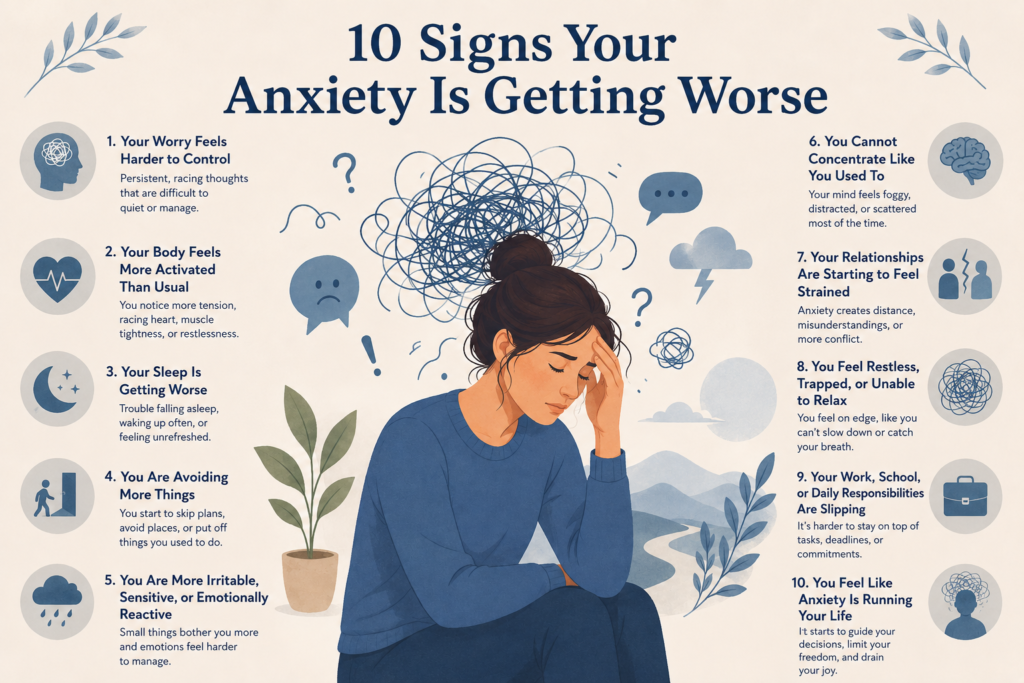
Anxiety is one of the most misunderstood human experiences. Most people think of it as “worry,” “overthinking,” or “being nervous,” but anxiety is much bigger than that. It can affect your thoughts, your body, your emotions, your sleep, your behavior, your relationships, and even the way you interpret reality in the moment.
At its core, anxiety is a protective response. It is your brain and body trying to prepare you for danger, uncertainty, pressure, or possible loss of control. That is why anxiety can feel so intense: your nervous system is not treating the situation like a casual thought. It is treating it like something that may require immediate action.
The tricky part is that anxiety does not only appear when danger is obvious. It can show up before a job interview, during a quiet night in bed, while reading an email, in a crowded room, after drinking too much coffee, or seemingly “out of nowhere.” And when it does, it can feel confusing, frustrating, and even scary.
The way I like to explain anxiety is this: anxiety is an alarm system. The problem is not that you have an alarm system. The problem is that sometimes the alarm becomes too sensitive, too loud, or too easily triggered.
According to the NHS, anxiety is usually a natural response to pressure, fear, or feeling threatened, and it can show up physically, mentally, and behaviorally. Mayo Clinic also explains that occasional anxiety is a normal part of life, but anxiety may become a disorder when worry or fear is intense, excessive, persistent, and interferes with daily activities.
This article breaks down what anxiety really is, why it happens, what is going on in the brain and body, why it can feel irrational even when it makes sense biologically, and when it may be time to seek support.
What Is Anxiety?
Anxiety is a state of heightened alertness caused by the possibility of threat, uncertainty, or future discomfort. Unlike fear, which usually responds to an immediate danger, anxiety often responds to something that might happen.
Fear says, “There is a threat right now.”
Anxiety says, “Something could go wrong.”
That future-focused quality is what makes anxiety so powerful. Your mind can imagine scenarios that have not happened yet, and your body can react as if those scenarios are already real.
For example, you might feel anxious before a presentation because your brain is predicting possible embarrassment. You might feel anxious about a medical test because your mind is scanning for worst-case outcomes. You might feel anxious in a relationship because uncertainty feels unsafe. In each case, anxiety is trying to protect you from pain, rejection, failure, danger, or loss.
The issue is that anxiety does not always measure risk accurately. Sometimes it overestimates danger and underestimates your ability to cope.
That is why anxiety can make ordinary situations feel urgent. A text message, a meeting, a bodily sensation, or a vague “bad feeling” can suddenly seem like evidence that something is wrong. Anxiety narrows your attention, speeds up your thoughts, and pushes your body into readiness.
In practical terms, anxiety often includes three layers:
- Thoughts: “What if something bad happens?”
- Body sensations: racing heart, tight chest, nausea, sweating, trembling, restlessness.
- Behaviors: avoiding, checking, asking for reassurance, escaping, procrastinating, or trying to control everything.
These layers feed each other. A worried thought can trigger a body sensation. A body sensation can trigger more worried thoughts. Then avoidance brings temporary relief, which teaches the brain that the avoided situation must have been dangerous.
That is how anxiety can become a loop.
Anxiety Is an Alarm System, Not a Character Flaw
One of the most important things to understand is that anxiety is not a sign of weakness. It is not a personality defect. It is not “being dramatic.” It is a nervous system response.
Your brain is built to keep you alive, not to keep you perfectly calm. From an evolutionary perspective, it is safer for the brain to overreact to a possible threat than to ignore a real one. If ancient humans heard a noise in the bushes, the ones who assumed “maybe predator” had a better survival chance than the ones who casually ignored it.
That same ancient alarm system still lives in the modern brain. The problem is that today’s “threats” are often not predators. They are deadlines, bills, social judgment, health concerns, relationship conflict, uncertainty, trauma memories, notifications, performance pressure, and constant mental stimulation.
Your body may respond to these modern pressures with the same biological systems designed for physical danger. That is why anxiety can feel so physical.
When you are anxious, your body may release stress hormones such as adrenaline and cortisol. The NHS explains that these hormones can be useful in some situations, but they can also cause symptoms like increased heart rate, sweating, and even panic in some people.
So, if your heart races during anxiety, your body is not “broken.” It is preparing you to respond. If your muscles tense, your body is bracing. If your stomach turns, your body is shifting energy away from digestion. If your breathing changes, your system is preparing for action.
Anxiety feels irrational when there is no obvious danger, but the body’s reaction follows a kind of internal logic: prepare, protect, survive.
The Difference Between Normal Anxiety and an Anxiety Disorder
Everyone feels anxious sometimes. That is normal. Anxiety before an exam, a medical appointment, a big decision, or a difficult conversation does not automatically mean something is wrong.
Normal anxiety is usually:
- connected to a specific situation;
- temporary;
- manageable;
- proportional to the challenge;
- reduced when the situation passes;
- not severely interfering with daily life.
An anxiety disorder is different. Cleveland Clinic describes anxiety disorders as mental health conditions involving fear, dread, and other symptoms that are out of proportion to the situation. Mayo Clinic notes that anxiety disorders can involve repeated episodes of intense anxiety, fear, or terror that may peak within minutes, as in panic attacks.
Anxiety may be moving into disorder territory when it is:
- excessive compared with the actual situation;
- persistent or difficult to control;
- interfering with work, school, relationships, sleep, or daily routines;
- causing avoidance of important parts of life;
- triggering panic attacks;
- creating constant worry or dread;
- connected to compulsive checking, reassurance-seeking, or escape behaviors.
The line is not always perfectly clear. A helpful question is:
Is anxiety helping me respond to life, or is it shrinking my life?
If anxiety pushes you to prepare for a presentation, that can be useful. If it makes you avoid career opportunities, relationships, travel, social situations, or basic responsibilities, it may need attention.
Why Does Anxiety Happen?
Anxiety happens because your brain is trying to detect danger, predict outcomes, and keep you safe. It is not caused by one single thing. It usually comes from a combination of biology, psychology, environment, learning, stress, and life experience.
Cleveland Clinic explains that anxiety disorders can involve a mix of neurotransmitters, hormones, brain changes, genetics, and environmental factors. Mayo Clinic similarly identifies possible causes and risk factors such as trauma, stress from illness, personality, other mental health conditions, drugs or alcohol, and inherited traits.
A simple way to think about it is this:
Anxiety happens when your brain believes something matters and something might go wrong.
That “something” can be physical, emotional, social, financial, relational, moral, or existential. Anxiety can attach itself to almost anything that feels uncertain or important.
Here are some common reasons anxiety happens.
Your Brain Is Trying to Predict and Prevent Danger
The brain is a prediction machine. It constantly asks:
- What is happening?
- What could happen next?
- Is this safe?
- Do I need to act?
- Have I seen something like this before?
Anxiety appears when the brain predicts possible danger or loss of control. This prediction can be based on the present moment, past experience, imagination, trauma, stress, or even subtle body sensations.
For example, if you once had a panic attack in a grocery store, your brain may later treat grocery stores as risky. Not because the store is objectively dangerous, but because your nervous system learned an association: “That place equals danger.”
This is how anxiety can become learned. The brain remembers not only events, but also contexts, sensations, smells, sounds, and emotional states. If something reminds your brain of a previous threat, anxiety can appear before you consciously understand why.
That is also why anxiety can feel like it comes “out of nowhere.” It may not be random. It may be responding to cues too subtle for conscious awareness.
The Fight-or-Flight Response: What Happens in Your Body
The fight-or-flight response is your body’s emergency mode. When your brain senses danger, it signals the body to prepare for action.
During anxiety, you may experience:
- faster heartbeat;
- quicker breathing;
- muscle tension;
- sweating;
- dry mouth;
- nausea;
- stomach discomfort;
- dizziness;
- trembling;
- chest tightness;
- hot flashes or chills;
- restlessness;
- feeling “wired” or on edge.
These symptoms can be uncomfortable, but they have a purpose. A faster heartbeat moves blood to muscles. Faster breathing brings in oxygen. Sweating helps regulate temperature. Muscle tension prepares movement. Heightened attention helps you scan for danger.
The problem is that these sensations can become frightening by themselves. A racing heart may lead to the thought, “What if I’m having a heart attack?” Shortness of breath may lead to, “What if I stop breathing?” Dizziness may lead to, “What if I pass out?”
Then the fear of the symptoms creates more symptoms.
This is especially common in panic attacks, where the body’s alarm system surges intensely and quickly. Mayo Clinic describes panic attacks as sudden feelings of intense anxiety, fear, or terror that reach a peak within minutes.
A panic attack can feel dangerous, but it is often the body’s fear system firing at full volume.
Why Anxiety Can Feel So Physical
Many people are surprised by how physical anxiety is. They expect anxiety to feel like worry, but instead they get chest tightness, stomach pain, headaches, tingling, dizziness, fatigue, or shortness of breath.
That happens because anxiety is not just a thought pattern. It is a whole-body state.
Your nervous system connects your brain, heart, lungs, stomach, muscles, hormones, and immune responses. When anxiety activates the stress response, your body shifts priorities. Digestion may slow down. Muscles may tighten. Breathing may become shallow. Your heart may beat harder. Your senses may become sharper.
This is why someone can understand logically that they are safe and still feel physically alarmed. The thinking brain may say, “Nothing is happening,” while the body says, “Prepare now.”
That mismatch is one reason anxiety can be so frustrating. People often try to argue themselves out of anxiety using logic alone. Logic helps, but it may not fully calm a nervous system that has already shifted into threat mode.
To calm anxiety, the body often needs signals of safety too: slower breathing, grounding, movement, warmth, rest, connection, and repeated experiences of facing manageable discomfort without escaping.
What Happens in the Brain During Anxiety?
Anxiety involves several brain systems, but three ideas are especially useful: threat detection, emotional memory, and regulation.
The Amygdala: Your Brain’s Threat Detector
The amygdala is often described as part of the brain’s threat-detection system. It helps notice danger and trigger protective responses. When the amygdala interprets something as threatening, it can activate the body before the rational mind has fully analyzed the situation.
This is why anxiety can be so fast.
You may feel anxious before you know why. Your body may react before your thoughts catch up. In a sense, anxiety can begin as a biological alarm before it becomes a verbal thought.
The Prefrontal Cortex: The Part That Tries to Think Clearly
The prefrontal cortex helps with reasoning, planning, perspective, impulse control, and decision-making. When anxiety is moderate, this part of the brain can help you evaluate the situation.
But when anxiety is intense, the threat system can dominate. That is when it becomes harder to think clearly, make decisions, or “just calm down.”
This does not mean you are irrational. It means your brain has shifted into protection mode. Protection mode is fast, emotional, and action-oriented. It is not designed for calm philosophical analysis.
Neurotransmitters, Stress Hormones, and the Anxiety Loop
Brain chemicals and stress hormones also play a role. Cleveland Clinic notes that anxiety disorders may involve neurotransmitters and hormones such as norepinephrine, serotonin, dopamine, and GABA.
You do not need to memorize brain chemistry to understand anxiety, but it helps to know this: anxiety is not “all in your head” in the dismissive sense. It is in your brain, body, hormones, learned patterns, attention, and behavior.
That is also why treatment often works best when it addresses multiple layers: thoughts, body sensations, avoidance patterns, lifestyle stressors, and sometimes medication.
Common Symptoms of Anxiety
Anxiety symptoms can look different from person to person. Some people mostly worry. Others feel anxiety in their stomach. Others become irritable, restless, perfectionistic, avoidant, or exhausted.
Mayo Clinic lists symptoms such as nervousness, restlessness, tension, sense of danger or panic, increased heart rate, rapid breathing, sweating, trembling, weakness, sleep problems, trouble concentrating, gastrointestinal problems, and difficulty controlling worry.
A useful way to organize symptoms is by category.
Mental and Emotional Symptoms
Anxiety can affect your inner world. You may notice:
- racing thoughts;
- worst-case-scenario thinking;
- constant “what if” questions;
- fear of losing control;
- dread;
- irritability;
- difficulty concentrating;
- feeling detached or unreal;
- fear that something bad is about to happen;
- obsessive worry;
- trouble making decisions.
Anxiety often makes uncertainty feel intolerable. The mind tries to solve that discomfort by thinking more. But overthinking can become fuel. The more you mentally scan for certainty, the more possibilities you find, and the more anxious you feel.
Physical Symptoms
Physical symptoms may include:
- racing heart;
- chest tightness;
- shortness of breath;
- stomach upset;
- nausea;
- sweating;
- shaking;
- headaches;
- jaw tension;
- neck and shoulder tension;
- dizziness;
- tingling;
- fatigue;
- sleep problems.
Physical symptoms are often the most frightening part of anxiety because they can feel like signs of a medical problem. Sometimes anxiety is the cause, but it is still important to talk to a healthcare professional if symptoms are new, severe, persistent, or unclear.
Behavioral Symptoms
Anxiety also changes what you do. You may:
- avoid certain places or situations;
- procrastinate;
- seek reassurance repeatedly;
- check your body, messages, locks, work, or decisions;
- leave situations early;
- overprepare;
- people-please;
- cancel plans;
- avoid conflict;
- rely on routines or safety behaviors.
These behaviors make sense in the short term. They reduce discomfort. But over time, they can teach the brain that avoidance is necessary for safety. That is one reason anxiety can grow.
Why Do I Feel Anxious When Nothing Is Wrong?
This is one of the most common and frustrating anxiety questions.
The answer is that anxiety does not always respond to obvious danger. It responds to perceived danger, uncertainty, accumulated stress, memory, prediction, and body signals.
You may feel anxious when “nothing is wrong” because something is happening below the surface.
Hidden Stress Buildup
Stress accumulates. You may handle work, family responsibilities, financial pressure, lack of sleep, unresolved conflict, too much screen time, and constant stimulation for weeks. Then one quiet moment arrives, and anxiety spikes.
It feels random, but your nervous system may simply be overloaded.
Think of anxiety like a smoke alarm. Sometimes it goes off because there is a fire. Sometimes it goes off because the room is smoky. Sometimes it goes off because the alarm is too sensitive.
Learned Fear and Past Experiences
The brain learns from experience. If you have been hurt, embarrassed, overwhelmed, abandoned, bullied, criticized, unsafe, or out of control in the past, your nervous system may become more alert to similar situations in the future.
This does not mean you are stuck. It means your brain adapted. Anxiety may be an old protection strategy that has not yet learned the present is different from the past.
Health, Sleep, Caffeine, and Other Body-Based Triggers
Your body can trigger anxiety too. Lack of sleep, too much caffeine, alcohol withdrawal, certain medications, hormonal changes, illness, pain, and some medical conditions can increase anxious sensations.
Mayo Clinic notes that anxiety can sometimes be related to medical causes, and Cleveland Clinic also recognizes that medical conditions and substances can be connected to anxiety symptoms.
This is why it is useful not to treat anxiety as purely psychological. Sometimes the nervous system is reacting to your lifestyle, physiology, or health status.
What Causes Anxiety to Become a Problem?
Anxiety becomes a problem when it becomes too intense, too frequent, too persistent, or too limiting. The goal is not to eliminate all anxiety. That would be unrealistic and, honestly, not even desirable. Some anxiety helps us prepare, focus, care, and respond.
The issue is when anxiety starts running the show.
Genetics and Temperament
Some people are naturally more sensitive to threat, uncertainty, conflict, or sensory stimulation. This can be influenced by temperament and family history. Mayo Clinic includes inherited traits among possible risk factors for anxiety disorders.
A sensitive nervous system is not bad. It may come with empathy, awareness, creativity, responsibility, and attention to detail. But without regulation skills, that sensitivity can become exhausting.
Trauma and Chronic Stress
Trauma can teach the brain that the world is unsafe. Chronic stress can teach the nervous system that it never gets to fully stand down.
If your body has spent months or years in survival mode, calm may feel unfamiliar. Sometimes people even feel anxious when things are peaceful because peace feels like waiting for the next problem.
This is not weakness. It is conditioning.
Avoidance: The Short-Term Relief That Keeps Anxiety Alive
Avoidance is one of the biggest reasons anxiety persists.
Here is the loop:
- Something makes you anxious.
- You avoid it.
- You feel relief.
- Your brain learns, “Avoidance kept me safe.”
- The situation feels even scarier next time.
Avoidance works immediately but often backfires long term. This is why exposure therapy can be helpful for certain anxiety disorders: it helps the brain learn, gradually and safely, that feared situations or sensations are manageable.
Cleveland Clinic notes that treatment for anxiety disorders often includes psychotherapy, including approaches like cognitive behavioral therapy, and medication when appropriate.
Types of Anxiety Disorders
Anxiety is a broad experience, but anxiety disorders have more specific patterns.
Generalized Anxiety Disorder
Generalized anxiety disorder, or GAD, involves excessive worry about everyday situations. Cleveland Clinic explains that GAD causes constant worry that is hard to manage and can disrupt daily life.
People with GAD may worry about health, money, family, work, performance, safety, or ordinary responsibilities. The worry can feel uncontrollable, even when the person knows it may be excessive.
Panic Disorder
Panic disorder involves recurring panic attacks and fear of having more panic attacks. A panic attack can include intense fear, racing heart, shortness of breath, chest discomfort, dizziness, trembling, sweating, nausea, or fear of dying or losing control.
The fear of panic can become a major part of the problem. People may begin avoiding places where panic happened before or where escape feels difficult.
Social Anxiety Disorder
Social anxiety disorder involves intense fear of being judged, embarrassed, rejected, or negatively evaluated. It is more than shyness. It can make everyday interactions feel threatening.
Someone with social anxiety may avoid speaking up, meeting new people, eating in public, dating, making phone calls, or attending events.
Specific Phobias
A specific phobia is an intense fear of a particular object or situation, such as flying, heights, needles, animals, storms, elevators, or driving.
The fear may seem excessive from the outside, but inside the body it can feel immediate and overwhelming.
Anxiety Related to Medical Conditions or Substances
Anxiety symptoms can also be connected to medical conditions, medications, substances, caffeine, withdrawal, or other physiological factors. That is why professional evaluation matters, especially when anxiety symptoms are new or intense.
Anxiety vs. Stress vs. Fear: What’s the Difference?
These words overlap, but they are not exactly the same.
| Experience | Main Focus | Example | Typical Time Frame |
|---|---|---|---|
| Fear | Immediate danger | A car swerves toward you | Present |
| Stress | Current pressure or demand | Too many deadlines | Present or near future |
| Anxiety | Possible future threat or uncertainty | “What if I fail?” | Future-focused |
Fear is usually about what is happening now.
Stress is usually about demands placed on you.
Anxiety is usually about what might happen next.
Of course, they can blend together. A stressful job can create anxiety. Anxiety can make normal stress feel dangerous. Fear can turn into future anxiety if the brain starts worrying that the same danger will happen again.
When Should You Seek Help for Anxiety?
You do not need to wait until anxiety is unbearable to ask for help. Support can be useful long before you hit a crisis point.
Consider talking to a healthcare professional or mental health provider if anxiety:
- interferes with work, school, relationships, parenting, or daily responsibilities;
- causes frequent panic attacks;
- leads to avoidance that shrinks your life;
- disrupts sleep regularly;
- causes distressing physical symptoms;
- feels impossible to control;
- is connected to trauma;
- leads to alcohol, drug, or medication misuse;
- is accompanied by depression or hopelessness.
Mayo Clinic advises seeking help when worry is hard to control, interferes with life, or is connected to depression, substance use, or other mental health concerns.
If you ever feel at risk of harming yourself, seek urgent help immediately through local emergency services or a crisis line.
How Anxiety Is Treated and Managed
Anxiety is treatable. That does not mean it disappears overnight, and it does not mean the same approach works for everyone. But many people improve with the right support, skills, and treatment plan.
Therapy and CBT
Cognitive behavioral therapy, or CBT, is one of the most commonly used therapies for anxiety. It helps people identify anxious thought patterns, understand avoidance behaviors, and practice new responses.
CBT is not just “think positive.” It is more practical than that. It asks:
- What am I predicting?
- What evidence am I using?
- What am I avoiding?
- What happens when I face this gradually?
- What would a more balanced response look like?
Exposure Therapy
Exposure therapy helps people gradually face feared situations, sensations, or memories in a structured way. The goal is not to overwhelm the person. The goal is to teach the brain: “I can handle this.”
Over time, the alarm system can become less reactive.
Medication When Appropriate
Medication can be helpful for some people, especially when anxiety is severe, persistent, or interfering with daily life. Medication decisions should always be made with a qualified healthcare professional.
Cleveland Clinic notes that anxiety disorder treatment may include psychotherapy and medication.
Lifestyle Habits That Support the Nervous System
Lifestyle does not replace professional treatment when treatment is needed, but it can support the nervous system.
Helpful habits may include:
- consistent sleep;
- regular movement;
- reducing excess caffeine;
- eating regularly;
- breathing exercises;
- mindfulness or grounding;
- limiting alcohol;
- reducing overstimulation;
- spending time with supportive people;
- creating predictable routines;
- journaling worries instead of mentally replaying them.
The key is not perfection. The key is giving your nervous system repeated signals of stability.
Final Thoughts: Anxiety Makes Sense, Even When It Feels Irrational
Anxiety can feel confusing because it often shows up without a clear emergency. But once you understand the system behind it, anxiety starts to make more sense.
It is your brain trying to protect you.
It is your body preparing for action.
It is your mind trying to predict pain before it happens.
It is your nervous system responding to uncertainty, memory, stress, and perceived threat.
That does not mean anxiety is always accurate. It does not mean you have to obey it. And it definitely does not mean you are weak.
Anxiety is an alarm. Sometimes the alarm is useful. Sometimes it is too sensitive. The work is learning how to listen without automatically surrendering control.
With understanding, support, and practice, anxiety can become less mysterious, less frightening, and less dominant in your life.
FAQs About Anxiety
Is anxiety dangerous?
Anxiety itself is usually not dangerous, but it can feel dangerous because it creates intense physical sensations. However, new, severe, or unclear symptoms should be checked by a healthcare professional.
Can anxiety cause chest tightness or shortness of breath?
Yes, anxiety can cause physical symptoms such as chest tightness, rapid breathing, increased heart rate, and sweating. The NHS explains that anxiety can trigger stress hormones like adrenaline and cortisol, which can create physical symptoms.
Why is anxiety worse at night?
Anxiety can feel worse at night because there are fewer distractions, the body is tired, and worries have more mental space. Poor sleep can also make the nervous system more reactive the next day.
Can anxiety go away without treatment?
Mild anxiety may improve with rest, stress reduction, lifestyle changes, and coping skills. But persistent, intense, or life-limiting anxiety often benefits from professional support.
What is the fastest way to calm anxiety?
A helpful first step is to signal safety to the body: slow your breathing, relax your muscles, name what you see around you, put your feet on the floor, and remind yourself that anxiety is uncomfortable but not automatically dangerous.
What is the difference between anxiety and an anxiety disorder?
Anxiety is a normal human response to stress, uncertainty, or threat. An anxiety disorder involves anxiety that is excessive, persistent, difficult to control, or disruptive to daily life. Mayo Clinic and Cleveland Clinic both emphasize interference with daily functioning and disproportionate fear as important signs.